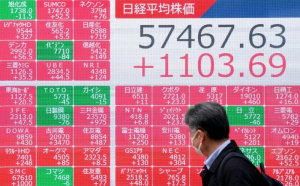

Futures linked to the main U.S. stock indices surge after the U.S. and Iran agreed to a temporary ceasefire in their more than month-old war. Iran’s agreement to allow for the safe passage of tanker traffic through the Strait of Hormuz also soothes some fears over global energy supply shortages, sending crude prices sharply lower, while gold recovers some lost ground as the dollar weakens. But Shell cuts its first-quarter gas production outlook and warns of uncertainty caused by the conflict.
Get fresh market insights with InvestingPro - now 50% off 1. Futures rally
U.S. stock futures shot higher on Wednesday, reflecting investor relief around the ceasefire deal to halt the war in the Middle East.
By 03:19 ET (07:19 GMT), the Dow futures contract had surged by 1,076 points, or 2.3%, S&P 500 futures had gained 168 points, or 2.5%, and Nasdaq 100 futures had jumped by 799 points or 3.3%.
The main averages on Wall Street were mostly subdued in the prior session, as traders nervously eyed an impending -- and ultimately averted -- U.S. deadline for Iran to reopen the Strait of Hormuz or face devastating military strikes. U.S. President Donald Trump earlier said on Tuesday that the U.S. would wipe out Iran’s "civilization" if his demands were not met, a statement that sparked debate over whether this was standard heated language from Trump or a real threat.
Ultimately, an 11th-hour agreement, mediated by Pakistan, was hashed out -- an announcement cheered by markets. Along with a sharp jump in global stocks and a fall in oil prices, U.S. government bonds rallied on renewed bets that Federal Reserve interest rate cuts may once again be on the table later this year. Previously, rate-reduction wagers for 2026 had been all but eradicated by the prospect of a war-induced energy shock fueling inflationary pressures.
In a note, analysts at Vital Knowledge suggested that stocks which have benefited from the conflict -- such as energy firms, commodity chemicals producers, and defense contractors -- "will probably suffer aggressive profit taking" following the ceasefire, while consumer discretionary names "should see the biggest rally."
2. U.S., Iran ceasefire agreement in focus
In a social media post, Trump said the agreement came after conversations with leaders from Pakistan, which has recently served as a mediator between the U.S. and Iran. With Pakistan calling on Trump to back down from his Tuesday 8 p.m. Eastern time deadline, the president promised to suspend his attack on Iran for two weeks.
Iran’s foreign minister, Abbas Araghchi, also said Tehran would "cease their defensive operation" and would make "safe passage" through the Strait of Hormuz possible if shipping is done in coordination with the Iranian military. Pakistani Prime Minister Shehbaz Sharif invited U.S. and Iranian officials to Islamabad for talks on Friday.
Israel, who launched a joint assault on Iran with the U.S. in late February, backed Trump’s decision, Prime Minister Benjamin Netanyahu’s office said in a statement. However, the comment did not include Lebanon, where Iran-aligned Hezbollah militants have been targeted by Israel.
The agreement offers some space for both sides to forge a long-term peace deal, although analysts at BCA Research flagged that "[a] near-term reprieve in the Iran conflict will not erase medium-term and strategic tensions."
3. Oil slumps below $100 a barrel
Oil prices tumbled in the wake of the agreement, sliding back below a $100 per barrel mark, but remaining well above pre-war levels.
By 03:44 ET (07:44 GMT), Brent crude futures, the global benchmark, had fallen by more than 13% to $94.85 per barrel, while U.S. West Texas Intermediate crude futures had slid by 14.8% to $96.23 a barrel.
Before the outbreak of the conflict in late February, Brent had been floating at around $70 per barrel. In the days following the start of the offensive, crude prices rocketed to around $120 a barrel at one point, fueling widespread fears over a jump in inflationary pressures that could weigh on global growth.
Feeding the uptick was the Strait of Hormuz, a narrow waterway off of Iran’s southern coast through which roughly a fifth of the world’s oil flows. Tehran launched an effective blockade of the strait, all but halting crucial energy supplies to countries around the world.
Asian nations, which heavily import oil passing through artery, were particularly exposed. At the same time, attacks on energy infrastructure in Persian Gulf countries further impacted shipments of natural gas to Europe. The U.S., although a net oil exporter, still saw an increase in gasoline-pump prices as worldwide oil costs rose.