U.S. stocks opened higher on Wednesday, while oil prices clawed back some earlier losses, as investors assessed hopes for an impending end to the war in Iran. President Donald Trump said the new Iranian regime had asked for a ceasefire.
At 09:32 ET (13:32 GMT), the benchmark S&P 500 index was up 0.7% to 6,574.43 points, the tech-heavy NASDAQ Composite added 1% to 21,796.11 points, and the blue-chip Dow Jones Industrial Average gained 0.7% to 46,673.19 points.
Track U.S. stock futures with InvestingPro - now 50% off Trump says new Iranian regime asked for ceasefire Trump on Wednesday said on his Truth Social service that "Iran’s New Regime President, much less Radicalized and far more intelligent than his predecessors, has just asked the United States of America for a CEASEFIRE!"
"We will consider when Hormuz Strait is open, free, and clear. Until then, we are blasting Iran into oblivion or, as they say, back to the Stone Ages!!!" the president added.
If confirmed by Iran, this would mark another significant step towards de-escalation, even with uncertainty around the Strait of Hormuz. The critical waterway through which a fifth of the world’s oil and gas supply flows has been effectively shuttered by Iran since the start of the conflict, leading to surging oil prices across the globe.
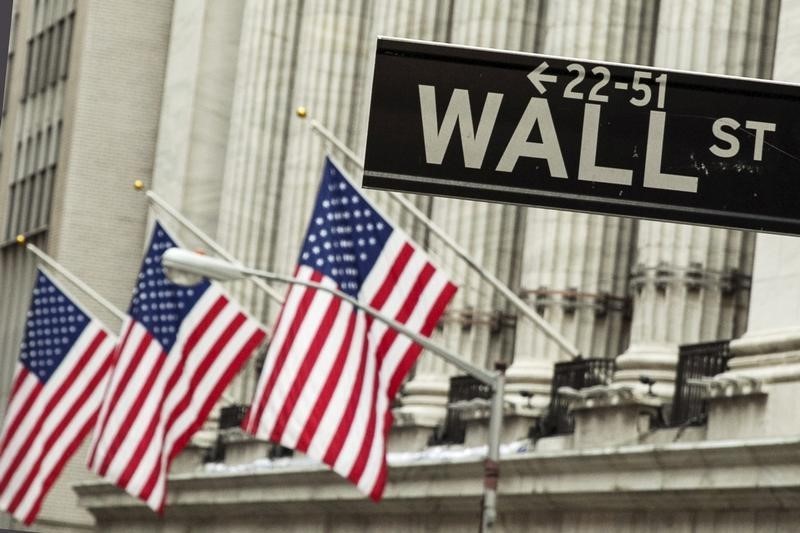
Wall Street coming off its best day since May 2025
The three main averages on Tuesday posted their best daily gain since May 12 last year, with the benchmark S&P 500 index gaining nearly 3% and the tech-heavy NASDAQ Composite adding almost 4%.
The euphoric relief rally was sparked by growing optimism that the U.S. will soon exit its joint assault with Israel against Tehran, which has escalated into a wider war threatening to engulf countries around the Middle East.
Underpinning these expectations was a Wall Street Journal article suggesting that U.S. President Donald Trump had told aides that he was open to leaving the war even if the Strait of Hormuz remained largely blocked to tanker traffic. In later remarks to reporters and posts on social media, Trump effectively confirmed the report, analysts at Vital Knowledge said in a note to clients. Meanwhile, Iran’s state TV quoted the country’s president as saying it was "prepared to end" the war if offered security guarantees.
Trump also reiterated that negotiations with Iran are going well, a claim that has been frequently disputed by officials in Tehran. However, Iran did acknowledge that messages are being exchanged between both sides, while the country’s president indicated that Iran has the "necessary will" to end the war should it receive guarantees that it will not be attacked again.
"There’s no doubt that yesterday’s rebound has been impressive and helped along by a pullback in oil prices. But the situation is muddied due to end of quarter position-squaring. It’s also challenging to express just what investors are pricing in, and what they’re not," David Morrison, senior market analyst at Trade Nation, said.
"For a start, investors are obviously desperate to add to their exposure at lower levels, calculating that hostilities are effectively over. They don’t believe there will be U.S. military boots on the ground, and any attempt to seize Kharg Island is now unlikely. But this could be a miscalculation, and the war may take longer to conclude than many are currently forecasting," he said.
"In addition, investors may not be factoring in the economic damage already done. Energy infrastructure around the Gulf has been damaged. Production has been halted, and will take time to restart, and the Strait of Hormuz remains effectively closed. Stock indices were due a rebound. But the test will be how resilient the current rally turns out to be," Morrison added.
Oil prices briefly dip below $100 Buoyed by the prospect of an imminent halt to hostilities, oil prices briefly sank back below $100 a barrel.
Futures contracts expiring in June for Brent crude, the global oil benchmark, were last down 2.1% to $101.75 a barrel. Following the outbreak of the war in late February, Brent had spiked to as high as almost $120 a barrel, compared to pre-conflict levels of around $70 a barrel.
U.S. West Texas Intermediate crude futures, meanwhile, dropped 1.3% to $100.10 a barrel.
Fueling the uptick was the effective closure of the Strait of Hormuz, a vital waterway tracing Iran’s southern coast through which about a fifth of the world’s oil flows. The constant threat of Iranian drone or missile attacks on vessels brought tanker traffic to all but a trickle, sparking fears over crucial supplies to countries around the globe.
Worries also abounded that the energy shock could ignite inflationary pressures, forcing central banks to consider interest rate hikes. Government bond yields climbed amid these expectations, weighing on stocks.
Speaking to reporters in the Oval Office on Tuesday, Trump said that the U.S. will be "leaving very soon," adding that White House’s goal of eradicating Iran’s nuclear threat had been "attained" and Washington does not need a formal deal to conclude the conflict.
But Trump, who will deliver an address to the nation this evening, has yet to say what he plans to do with the Strait of Hormuz.
Trump, who has expressed frustration with a refusal by some U.S. allies to allow their bases to be used as staging posts for American military actions against Iran, has earlier called on these countries to forcibly "take" the waterway. The rift became more apparent on Wednesday, when Trump said in an interview published by Britain’s Telegraph newspaper that he was strongly considering taking the U.S. out of NATO, calling the longstanding alliance a "paper tiger."