
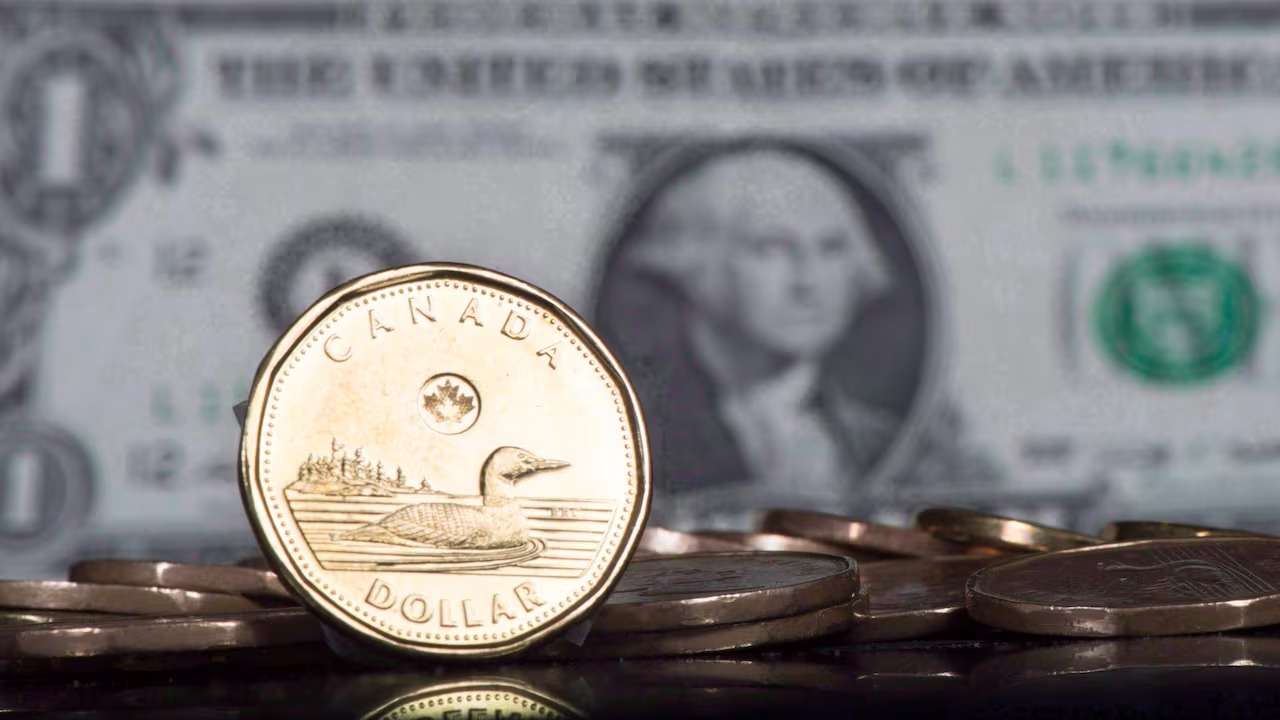
The U.S. dollar has been pushing higher against the Canadian dollar, extending its bull run to 1.4024, but the chart is starting to flash some warning signs that the rally could be on borrowed time.
Get a look at the day ahead in U.S. and global markets with the Morning Bid U.S. newsletter. Sign up here. The advance has been driven in part by a widening gap in monetary policy between the United States and Canada. The interest rate differential is roughly 1.25 - 1.50 percentage points in favor of the U.S. dollar, which has given the greenback a structural edge. Canada's economy also contracted at an annualized rate of 0.1% in the first quarter, following a revised 1.0% contraction in the previous quarter, adding further pressure on the Canadian dollar, also known as the loonie.
On the charts, early signals of the latest leg higher came from candle patterns — a way of reading price behavior using bar-shaped graphics. Long lower shadows on Tuesday's and Wednesday's candles, meaning the currency dipped during those sessions but recovered to close higher, warned that buyers were stepping in and gaining the upper hand. The move has also been supported by the 10-day moving average at 1.3922, according to data supplied by LSEG. A moving average smooths out day-to-day price swings to reveal the broader trend and is generally seen as a bullish sign when prices stay above it.
The rally is showing signs of strain, however. The daily Relative Strength Index, or RSI — a tool that measures how fast and how far prices have moved — has been drifting sideways in overbought territory, suggesting the market may have come too far, too fast. That warning was underscored on Thursday, when the USD/CAD pair failed to hold its gains above the psychologically important 1.4000 level and closed below it, leaving a long upper candle shadow. That kind of pattern, where prices spike higher during the day but retreat by the close, is typically read as a bearish signal.
For now, the Canadian dollar is expected to remain under pressure. If the greenback were to move back above 1.4024, the market would probably gravitate toward 1.4140, the high from November 2025. But, if the U.S. dollar drops below 1.3892, the 100-week moving average and weekly Ichimoku cloud base — a widely used statistical tool that attempts to identify bullish and bearish territory — the outlook could change in favor of the loonie.